

wyatt earp la leggenda
| The Life and Legend of Wyatt Earp | |
|---|---|
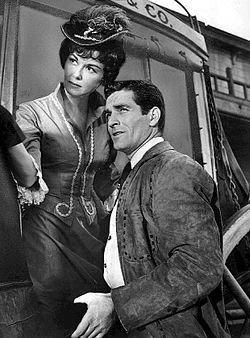 Hugh O'Brian as Wyatt Earp and Adele Mara (1961) | |
| Genre | Western |
| Written by | Paul Landres Frank McDonald |
| Directed by | Frederick Hazlitt Brennan John Dunkel Daniel B. Ullman |
| Starring | Hugh O'Brian Mason Alan Dinehart Douglas Fowley |
| Composers | Herman Stein Ken Darby |
| Country of origin | United States |
| Original language | English |
| No. of seasons | 6 |
| No. of episodes | 229 |
| Production | |
| Executive producers | Louis F. Edelman Robert Sisk |
| Running time | 30 mins. |
| Production companies | Wyatt Earp Enterprises Desilu Productions |
| Distributor | ABC Films (1961-1963) SFM Entertainment |
| Release | |
| Original network | ABC |
| Original release | September 6, 1955 (1955-09-06) – June 27, 1961 (1961-06-27) |
The Life and Legend of Wyatt Earp is the first Western television series written for adults,[1] premiering four days before Gunsmoke on September 6, 1955.[2] [3] Two weeks later came the Clint Walker western Cheyenne. The series is loosely based on the life of frontier marshal Wyatt Earp. The half-hour, black-and-white program aired for six seasons (229 episodes) on ABC from 1955 to 1961, with Hugh O'Brian in the title role.
Plot [edit]
The first season of the series purports to tell the story of Wyatt's experiences as deputy town marshal of Ellsworth, Kansas (first four episodes) and then as town marshal in Wichita. In the second episode of the second season, first aired September 4, 1956, he is hired as assistant city marshal of Dodge City, where the setting remained for three seasons. The final episode set in Dodge City (Season 5, Episode 1 - "Dodge City: Hail and Farewell") aired on September 1, 1959. Beginning the next week on September 8, 1959 (Season 5, Episode 2 - "The Trail to Tombstone"), the locale shifted to Tombstone, Arizona Territory, for the remainder of the series.
Cast [edit]
Main cast [edit]
- Hugh O'Brian as Wyatt Earp (229 episodes)
- John Anderson/Ross Elliott as Virgil Earp (5 episodes/4 episodes)
- Ray Boyle as Morgan Earp (15 episodes)
- Douglas Fowley/Myron Healey as John H. "Doc" Holliday (49 episodes/10 episodes)
- Carol Montgomery Stone/Collette Lyons as "Big Nose Kate" (10 episodes/4 episodes)
- Mason Alan Dinehart as Bat Masterson (34 episodes)
- Steve Brodie/Lash La Rue as Sheriff Johnny Behan, member of the Ten Percent Ring (9 episodes/8 episodes)
- Jimmy Noel as townsman (144 episodes)
- Buddy Roosevelt as townsman (65 episodes)
- Rico Alaniz as Mr. Cousin (19 episodes)
- Rodd Redwing as Mr. Brother (8 episodes)
- Trevor Bardette as Newman Haynes Clanton (21 episodes)
- John Milford as Ike Clanton (8 episodes)
- Carol Thurston as Emma Clanton (7 episodes)
- William Phipps as Curly Bill Brocius (16 episodes)
- William Tannen as Deputy Hal Norton (56 episodes)
- Morgan Woodward as "Shotgun" Gibbs (42 episodes)
- Randy Stuart as Nellie Cashman (12 episodes)
- Paul Brinegar/Ralph Sanford as James H. "Dog" Kelley (34 episodes/21 episodes)
- Margaret Hayes as Dora Hand (3 episodes)
- Don Haggerty as Marsh Murdock (21 episodes)
- James Seay as Judge Wells Spicer (16 episodes)
- Damian O'Flynn as Judge Tobin/Dr. Goodfellow/Doc Fabrique
- Denver Pyle/Walter Coy as Ben Thompson (8 episodes/1 episode)
- Bob Steele as Deputy Sam (4 episodes)
Guest cast [edit]
On September 25, 1956, Myron Healey played a drunken gunfighter Clay Allison, who comes into Dodge City to confront the Earp legend. In the story line, Pete Albright, a storeowner played by Charles Fredricks, tries to hire Allison to gun down Earp because the marshal is fighting crime in the town and costing merchants business in the process. Allison makes a point of not taking money, but is willing to challenge Earp until he is overcome by his own drunkenness.[4] Mike Ragan played Clay Allison in a 1957 episode, "The Time for All Good Men".[5]
Other notable performers were Rachel Ames (in the 1958 episode "The Schoolteacher"), Jim Bannon (three times), Roy Barcroft (three times), Lane Bradford (six times, including the role of the Cheyenne Chief Two Moon in the 1957 episode "Indian Wife"[6]), Robert Bray (three times), Virginia Christine, Andy Clyde (as Billy Buckett), Tris Coffin, Elisha Cook, Jr. (as gunsmith "Guns" McCallum in "The Equalizer"), Carolyn Craig (as Edna Granger in "County Seat War"), Francis De Sales (three times), Richard Devon (twice), Tiger Fafara, Ron Foster (as Johnny in "Arizona Lottery"), Robert Fuller, Connie Gilchrist (in "Pinkytown", the story of an outlying saloon community which resists annexation into Dodge City), Ron Hagerthy, Robert Harland, and Brad Johnson (twice, as Bat Masterson's brother Ed Masterson in the 1957 episode "The Nice Ones Always Die First" and as the artist Hurley Abbott in the 1958 segment "The Underdog").[7]
Still more guest stars included Ed Hinton, Jonathan Hole (twice), Rodolfo Hoyos, Jr., I. Stanford Jolley (six times, including "A Papa for Butch and Ginger"), Brett King (twice), Jimmy Lydon (twice), Walter Maslow (as the outlaw Blackie Saunders), Francis McDonald (in "Old Jake", a story of revenge stemming from the Sand Creek massacre),[8] Tyler McVey (seven times), Carol Ohmart (as actress Cora Campbell), Gregg Palmer (five times as Tom McLowery), House Peters, Jr. (four times as Wichita saloon owner Dave Bennett), John M. Pickard (three times, once as the gunfighter Johnny Ringo), Paula Raymond, Grant Richards (as gunfighter and saloonkeeper Luke Short), Roy Roberts (as the Texas cattle baron Shanghai Pierce[9] ), Thayer Roberts (as General William Tecumseh Sherman), Bing Russell (twice), Stuart Randall (seven times), Isabel Randolph (as Grandma Wilkins in "Wyatt Earp Rides Shotgun"), Glenn Strange (five times), Gloria Talbott, John Vivyan, Gloria Winters, Sheb Wooley (twice), and Anna May Wong. Frank Stillwell was portrayed by John Baxter in season 5.[7]
Production [edit]
Development [edit]
The series was produced by Desilu Productions and filmed at the Desilu-Cahuenga Studio. Sponsors included General Mills, Procter & Gamble, and Parker Pen Company. An off-camera barbershop quartet sang the theme song and hummed the background music in early episodes. The theme song "The Legend of Wyatt Earp" was composed by Harry Warren. Incidental music was composed by Herman Stein.
Casting [edit]
O'Brian was chosen for the role in part because of his physical resemblance to early photographs of Wyatt Earp.
The series had a large supporting cast of more than 30 actors during its six-year run. Jimmy Noel was cast in 144 episodes as an unnamed, uncredited townsman; Buddy Roosevelt appeared similarly in 65 episodes of the series. William Tannen played Deputy Hal Norton in 56 episodes which aired between 1956 and 1958; in some of the segments he was uncredited, and in most his role was tangential to the script. Randy Stuart was cast in 12 episodes in the 1959–1960 season as Tombstone saloon and hotel owner Nellie Cashman, a romantic interest for Earp. Earlier she played Nellie Dawson, a widow living on a ranch, in "Little Gray Home in the West".[10]
In five episodes, John Anderson played Earp's brother, Virgil Earp; in four other episodes, including "Big Brother Virgil" and "The Trail to Tombstone", Ross Elliott played the part of Virgil. In 15 segments from 1956 to 1961, Ray Boyle, then using the stage name "Dirk London", portrayed another brother, Morgan Earp. Between 1958 and 1961, Morgan Woodward, later on CBS's Dallas in the role of Marvin "Punk" Anderson and a frequent guest star on Gunsmoke, as well, played folksy loyal deputy "Shotgun" Gibbs in 42 episodes.
Douglas Fowley and Myron Healey were cast 49 and 10 times, respectively, as Earp's close friend John H. "Doc" Holliday, whom Earp had met in Texas prior to 1880. Carol Montgomery Stone played Kate Holliday or "Big Nose Kate", Holliday's common-law wife, in 10 episodes of the series in the 1957–1958 season. Collette Lyons played Big Kate in two 1958 episodes and "Rowdy Kate" in two other segments in 1955 and 1956. At times Holliday seemed affectionate toward Kate; at other time, he seemed oblivious to her existence.[11]
Earlier, on September 25, 1956, Healey played a drunken gunfighter Clay Allison, who comes into Dodge City to confront the Earp legend. In the story line, Pete Albright, a storeowner played by Charles Fredricks, tries to hire Allison to gun down Earp because the marshal is fighting crime in the town and costing merchants business in the process. Allison makes a point of not taking money, but is willing to challenge Earp until he is overcome by his own drunkenness.[12] Mike Ragan played Clay Allison in a 1957 episode, "The Time for All Good Men".[13]
Mason Alan Dinehart, or Alan Dinehart, III, son of film stars Alan Dinehart and Mozelle Britton, was cast in 34 episodes between 1955 and 1959 as Bat Masterson, a role filled on the NBC series of the same name by the late Gene Barry. Dinehart played Masterson from the ages of 19 to 23.[7]
The bearded Paul Brinegar in 33 episodes played James H. "Dog" Kelley, a veteran of the Union Army, the owner of the Alhambra Saloon, and a city council member and then the mayor while Earp is the deputy marshal in Dodge City. Their paths in history crossed for no more than one year. In the second and third episodes of the second season of the series, set in Dodge City and titled "Dodge City Gets a New Marshal" (September 4, 1956)[14] and "Fight or Run" (September 11, 1956), Kelley is the hold-out vote on the city council regarding Earp's plan to require gun owners to check in their weapons upon entering town. The Big T Cattle Company, angry with Earp for trying to clean up Dodge City and reduce business from the cowboys, enlists Kelley's help in arranging an ambush of Earp. Kelley is depicted as a reluctant "good guy"/"bad guy" split personality in many of the episodes in which he appears.[15]
Paul Brinegar subsequently played the cantankerous cooks Wishbone and Jelly Hoskins on the CBS Westerns, Rawhide and Lancer. In three episodes, Margaret Hayes was cast as Dora Hand, the popular dance-hall actress and singer who had a romantic interest in Mayor Kelley. She is inadvertently shot to death in October 1878 by a rival suitor, James W. "Spike" Kenedy, a son of the South Texas rancher baron Mifflin Kenedy.[16] In "It Had to Happen" (April 1, 1958), after Masterson is slightly wounded from a gunshot fired by a man whom Earp had struck in the shoulder to avoid killing him, Mayor Kelley orders Earp to "shoot to kill" when apprehending lawbreakers. Earp, however, has always used restraint and tried to avoid killing those who would fire upon him. When Earp kills a culprit, he has second thoughts about his role as a lawman.[17]
Don Haggerty was cast in the role of Wichita newspaperman Marsh Murdock in 21 segments of the first season. Trevor Bardette was cast 21 times as the unscrupulous Newman Haynes Clanton, known as Old Man Clanton, when the setting of the series moved to Arizona, but Bardette appeared in earlier episodes, too, under other names. John Milford appeared in eight episodes as the historical Ike Clanton. In seven episodes in 1959 and 1961, Carol Thurston played the fictitious Emma Clanton, daughter of Old Man Clanton and an unlikely romantic interest for Earp. Thurston also was cast in different roles in four earlier episodes before she landed the continuing role as Emma Clanton. James Seay was cast 16 times as Judge Spicer, who became a close friend of Earp's.
William Phipps in 16 episodes played the gunman and rustler Curly Bill Brocius. In the episode "The Clantons' Family Row", Brocius is facing a potential gunfight with Johnny Ringo (Peter M. Thompson), who is irate that Brocius accidentally shot and killed Ringo's horse, though he replaced the animal with another. Earp works to stop the gunfight from happening, and Doc Holliday proceeds to take bets on the outcome.[18] In "Let's Hang Curly Bill", an older marshal, Fred White (Sam Flint), is mortally wounded when he takes the gun from a drunken Curly Bill, who is celebrating his birthday in a saloon in Tombstone. A town mob demands that Curly Bill be hanged, but Earp places dynamite under the main street to protect his prisoner until the trial. Earp must defend Curly Bill in court because White accidentally caused Curly Bill's gun to discharge; White signed a statement attesting to the facts prior to his death. Doc Holliday noted at the end of the episode that Earp could have merely let Curly Bill hang for past crimes had he not been a just marshal.[19]
Steve Brodie played the dishonest Cochise County Sheriff Johnny Behan in 9 episodes from 1960 to 1961; Lash La Rue played him in eight other segments, one uncredited. La Rue first appeared in the October 20, 1959 segment, "You Can't Fight City Hall" as an agent of territorial Governor John Charles Frémont.[7]
Damian O'Flynn, a Boston native, was cast in a combined 60 episodes, as Judge Tobin in the Dodge City segments and as Dr. Goodfellow, when the setting shifts to Tombstone; in the Wichita episodes, he plays Doc Fabrique. Many episodes show Douglas Fowley as playing the part of Doc Fabrique when he actually is not in the episodes. O'Flynn was left off the credits most of the time. – Correction: Douglas Fowley not Damian O'Flynn played Dr Fabrique, as per the original credits– In "Frontier Surgeon" (January 19, 1960), Dr. Goodfellow must obtain a truce with Marshal Earp, who is apprehending a wounded outlaw. The man will die if moved after surgery, but he does not wait the three days to recuperate out of distrust of Earp and the protection of the $15,000 loot his gang and he have taken from Wells Fargo.[20]
Walter Coy appeared twice on The Life and Legend of Wyatt Earp, as Henry Mason in "The Doctor" (1960) and as Ben Thompson in "Dodge Is Civilized" (1959). In eight other episodes beginning at the start of the series, Denver Pyle had portrayed Ben Thompson, the gunfighter who was Earp's sometimes rival and reluctant friend, and who later became the marshal in Austin.[7] Pyle was cast as Thompson beginning with the second episode of the series. In "Bill Thompson Gives In" (September 20, 1955), Earp uses a pair of Indian scouts, rather than a posse, to help capture Ben Thompson and his brother, Billy Thompson (Hal Baylor), who when inebriated killed the previous Ellsworth sheriff, Chauncey Whitney.[21] The killing was subsequently ruled accidental.
In "Marshal Earp Meets General Lee", Earp uses creativity to defuse a tense situation involving a former Confederate officer and cattle drovers who threaten to tear down Ellsworth. Earp simply declares January 19, 1874, the 67th birthday of General Robert E. Lee, as "Robert E. Lee Day" in Ellsworth and pays respect to Lee as a defeated warrior.[22]
Bob Steele played Wyatt's deputy, Sam, in four episodes in 1955 during the Wichita period.[23]
The two actors who portrayed Earp's Cheyenne friends and informers were Rico Alaniz, a native of Mexico, Mr. Cousin in 19 episodes between 1955 and 1959, and Rodd Redwing as Mr. Brother in eight episodes. The role of Mr. Brother ended with the 1958 episode "One" because the character is killed by four outlaws called the Dry Gulch Gang. Earp spent several subsequent episodes entitled "Two", "Three", and "Four" apprehending the gang.[24]
Use of Buntline Special [edit]
In the show, O'Brian openly carried a Buntline Special, a pistol with a 12-inch barrel, which triggered a mild toy craze at the time the series was originally broadcast. No credible evidence has been found that Wyatt Earp ever owned such a gun. The myth of Earp carrying a Buntline Special was created in Stuart N. Lake's best-selling 1931 biography Wyatt Earp: Frontier Marshal, later admitted by the author to be highly fictionalized.[25]
Historical Accuracy [edit]
The real Wyatt Earp was appointed as an assistant marshal in Dodge City around May 1876, spent the winter of 1876–77 in Deadwood, Dakota Territory,[26] : 31 and rejoined the Dodge City police force as an assistant marshal in spring 1877. He resigned his position in September 1879.[27] Earp is depicted as the town marshal in Tombstone, although his brother Virgil Earp was Deputy U.S. Marshal and Tombstone City Marshal.[28] : 28 As city marshal, Virgil made the decision to enforce a city ordinance prohibiting carrying weapons in town and to disarm the outlaw cowboys that led to the Gunfight at the O.K. Corral. Wyatt was only a temporary assistant marshal to his brother.[29]
Series overview [edit]
Episodes [edit]
Season 1 (1955–56) [edit]
Season 2 (1956–57) [edit]
Season 3 (1957–58) [edit]
Season 4 (1958–59) [edit]
Season 5 (1959–60) [edit]
Season 6 (1960–61) [edit]
Reception [edit]
Ratings [edit]
The Life and Legend of Wyatt Earp finished number 18 in the Nielsen ratings for the 1956–1957 season, number six in 1957–1958, number 10 in 1958–1959, and number 20 in 1959–1960.[53]
Awards [edit]
The series received two Emmy nominations in 1957. Hugh O'Brian was nominated for Best Continuing Performance by an Actor,[54] and Dan Ullman earned a nomination for Best Teleplay Writing - Half Hour or Less.[55]
Home media [edit]
Infinity Entertainment Group released the complete first season on DVD in Region 1 for the first time on April 21, 2009.[56] This release has been discontinued and is now out of print. On October 28, 2011, Inception Media Group acquired the rights to the series. It subsequently re-released the first season on DVD on December 13, 2011.[57] Season two was released on March 12, 2013.[58]
| DVD Name | Ep # | Release Date |
|---|---|---|
| Season 1 | 33 | December 13, 2011 |
| Season 2 | 39 | March 12, 2013 |
[edit]
O'Brian recreated the role of Earp in two episodes of the CBS television series Guns of Paradise (1990) alongside Gene Barry as Bat Masterson and again in 1991 in The Gambler Returns: The Luck of the Draw, also with Barry as Masterson. An independent movie, Wyatt Earp: Return to Tombstone, was released in 1994 featuring new footage of O'Brian as Earp mixed with flashbacks consisting of colorized scenes from the original series.[59] The new sequences co-starred Bruce Boxleitner (who had himself played Earp in the telefilm I Married Wyatt Earp), Paul Brinegar (who later joined the Rawhide cast), Harry Carey, Jr. (who had, a year earlier, played Marshal Fred White in Tombstone), and Bo Hopkins.
With the emergence of television in the 1950s, producers spun out a large number of Western-oriented shows. At the height of their popularity in 1959, more than two dozen "cowboy" programs were on weekly. At least five others were connected to some extent with Wyatt Earp: Bat Masterson, Tombstone Territory, Broken Arrow, Johnny Ringo, and Gunsmoke.[60]
Episodes of The Life and Legend of Wyatt Earp are rebroadcast on the cable television network, Grit. Two episodes of the show are aired daily on Cozi TV.
References [edit]
- ^ Burris, Joe (May 10, 2005). "The Eastern Earps". Baltimore Sun . Retrieved October 20, 2014.
- ^ The Life and Legend of Wyatt Earp at IMDb
- ^ The Life and Legend of Wyatt Earp at IMDb
- ^ ""Clay Allison", September 25, 1956". Internet Movie Data Base. Retrieved March 26, 2014.
- ^ ""The Time for All Good Men" (June 4, 1957)". Internet Movie Data Base. Retrieved April 18, 2014.
- ^ "Indian Wife, December 10, 1957". Internet Movie Data Base. Retrieved November 21, 2013.
- ^ a b c d e f "Full Cast and Crew for The Life and Legend of Wyatt Earp". Internet Movie Data Base. Retrieved January 23, 2013.
- ^ ""Old Jake", The Life and Legend of Wyatt Earp, April 9, 1957". Internet Movie Data Base. Retrieved March 29, 2013.
- ^ ""The Big Bellyache", September 24, 1957". Internet Movie Data Base. Retrieved April 21, 2014.
- ^ ""Little Gray Home in the West", May 5, 1959". Internet Movie Data Base. Retrieved May 26, 2014.
- ^ "Fred Stone's Daughter, Carol, Now on ABC-TV". The Chicago Tribune. May 12, 1957. Retrieved 2009-06-30 .
Fred Stone's Daughter, Carol, Now on ABC-TV. Carol Stone, plays Big Kate on ABC-TV's Life and Legend of Wyatt Earp, is a daughter of musical comedy star ...
- ^ ""Clay Allison", September 25, 1956". Internet Movie Data Base. Retrieved March 26, 2014.
- ^ ""The Time for All Good Men" (June 4, 1957)". Internet Movie Data Base. Retrieved April 18, 2014.
- ^ ""Dodge City Gets a New Marshal", September 4, 1956". Internet Movie Data Base. Retrieved March 25, 2014.
- ^ ""Fight or Run", September 11, 1956". Internet Movie Data Base. Retrieved March 25, 2014.
- ^ "Susan Leiser Silva and Lee A. Silva, "The Killing of Dora Hand", October 1, 2009". historynet.com; originally in Wild West Magazine. Retrieved April 13, 2014.
- ^ ""It Had to Happen", April 1, 1958". Internet Movie Data Base. Retrieved May 11, 2014.
- ^ ""The Clantons' Family Row", December 8, 1959". Internet Movie Data Base. Retrieved August 12, 2013.
- ^ ""Let's Hang Curly Bill" (January 26, 1960)". Internet Movie Data Base. Retrieved January 20, 2014.
- ^ ""Frontier Surgeon" (January 19, 1960)". Internet Movie Data Base. Retrieved January 20, 2014.
- ^ "Bill Thompson Gives In", September 20, 1955". Internet Movie Data Base. Retrieved March 3, 2014.
- ^ ""Marshal Earp Meets General Lee", September 27, 1955". Internet Movie Data Base. Retrieved March 3, 2014.
- ^ "Bob Steele (1907-1988)". Internet Movie Data Base. Retrieved March 3, 2014.
- ^ ""One", April 15, 1958". Internet Movie Data Base. Retrieved May 14, 2014.
- ^ Shillingberg, William B. (Summer 1976). "Wyatt Earp and the Buntline Special Myth". Kansas Historical Quarterly. 42 (2): 113–154.
- ^ Woog, Adam (February 28, 2010). Wyatt Earp. Chelsea House Publications. ISBN978-1-60413-597-8.
- ^ Gatto, Steve. "Dodge City (1876–1879)". Retrieved April 11, 2011.
- ^ Lubet, Steven (2004). Murder in Tombstone: the Forgotten Trial of Wyatt Earp. New Haven, CT: Yale University Press. p. 288. ISBN978-0-300-11527-7 . Retrieved November 29, 2011.
- ^ Linder, Douglas, ed. (2005). "Testimony of Virgil Earp in the Preliminary Hearing in the Earp Case". Famous Trials: The O. K. Corral Trial. Archived from the original on February 3, 2011. Retrieved February 6, 2011.
- ^ ""John Wesley Hardin", November 1, 1955". Internet Movie Data Base. Retrieved March 6, 2014.
- ^ ""The Frontier Theatre", February 7, 1956". Internet Movie Data Base. Retrieved October 8, 2013.
- ^ ""The Desperate Half-Hour", February 28, 1956". Internet Movie Data Base. Retrieved October 9, 2013.
- ^ "One of Jesse's Gang, March 13, 1956". Internet Movie Data Base. Retrieved October 11, 2013.
- ^ "The Pinkertons, March 20, 1956". Internet Movie Data Base. Retrieved October 11, 2013.
- ^ "King of the Frontier, November 11, 1958". Internet Movie Data Base. Retrieved May 20, 2014.
- ^ "The Suffragette, March 27, 1956". Internet Movie Data Base. Retrieved October 11, 2013.
- ^ ""Hang 'em High", March 27, 1957". Internet Movie Data Base. Retrieved November 1, 2013.
- ^ ""Dull Knife Strikes for Freedom", May 7, 1957". Internet Movie Data Base. Retrieved April 16, 2014.
- ^ ""The Wicked Widow", May 21, 1957". Internet Movie Data Base. Retrieved April 17, 2014.
- ^ "Woman Trouble, December 17, 1957". Internet Movie Data Base. Retrieved November 21, 2013.
- ^ "Doc Holliday Rewrites History, May 6, 1958". Internet Movie Data Base. Retrieved May 14, 2014.
- ^ ""The Gatling Gun", October 21, 1958". Internet Movie Data Base. Retrieved June 15, 2013.
- ^ ""A Good Man" (January 6, 1959)". Internet Movie Data Base. Retrieved July 13, 2013.
- ^ ""A Murderer's Return" (January 5, 1960)". Internet Movie Data Base. Retrieved August 12, 2013.
- ^ ""The Truth About Rawhide Geraghty" (February 17, 1959)". Internet Movie Data Base. Retrieved July 9, 2013.
- ^ ""She Almost Married Wyatt" (February 24, 1959)". Internet Movie Data Base. Retrieved July 9, 2013.
- ^ ""Horse Race" (March 3, 1959)". Internet Movie Data Base. Retrieved July 9, 2013.
- ^ "Juveniles - 1878 (March 10, 1959)". Internet Movie Data Base. Retrieved July 10, 2013.
- ^ ""The Noble Outlaws", November 24, 1959". Internet Movie Data Base. Retrieved January 23, 2013.
- ^ ""Silver Dollar" (February 2, 1960)". Internet Movie Data Base. Retrieved September 12, 2013.
- ^ "Don't Get Tough with a Sailor (February 23, 1960)". Internet Movie Data Base. Retrieved September 21, 2013.
- ^ "Casey and the Clowns (February 21, 1961)". Internet Movie Data Base. Retrieved August 18, 2014.
- ^ "ClassicTVHits.com: TV Ratings".
- ^ "The Life and Legend of Wyatt Earp".
- ^ "Wyatt Earp".
- ^ "The Life and Legend of Wyatt Earp DVD news: Press Release for The Life and Legend of Wyatt Earp - Complete Season 1 - TVShowsOnDVD.com". Archived from the original on 2012-11-04.
- ^ "The Life and Legend of Wyatt Earp DVD news: Press Release for The Life and Legend of Wyatt Earp - The Complete Season 1 (Inception Media) - TVShowsOnDVD.com". Archived from the original on 2012-02-08.
- ^ "The Life and Legend of Wyatt Earp DVD news: Press Release for The Life and Legend of Wyatt Earp - Season 2 - TVShowsOnDVD.com". Archived from the original on 2013-02-25.
- ^ "Retro : The Wonder of Wyatt: Mixing the Old Series With New Scenes Brings Earp Back to TV--and Tombstone". The Los Angeles Times . Retrieved 2010-12-05 .
- ^ Guinn, Jeff. The Last Gunfight: The Real Story of the Shootout at the O.K. Corral and How it Changed the American West (1st Simon & Schuster hardcover ed.). New York: Simon & Schuster. ISBN978-1-4391-5424-3.
External links [edit]
- Wyatt Earp and the "Buntline Special" Myth
- The Life and Legend of Wyatt Earp at IMDb
- Wyatt Earp: Return to Tombstone at IMDb
- The Gambler Returns: The Luck of the Draw at IMDb
- The Guns of Paradise at IMDb
- Production notes on TV series
wyatt earp la leggenda
Source: https://en.wikipedia.org/wiki/The_Life_and_Legend_of_Wyatt_Earp
Posted by: vanaukenaling1994.blogspot.com
0 Response to "wyatt earp la leggenda"
Post a Comment